A Strategy of Liberation Requires Emancipation by Nahida the Exiled Palestinian
wrong with Jewish ActivismGilad Atzmon is a jazz & world music artist, a novelist and an author focusing on ID politics.
Welcome to Gilad Atzmon's webpage. This site provides information about Gilad's musical and intellectual activity.
wrong with Jewish ActivismOn the eve of the Gaza Flotilla Mission. A talk given in Kyttaro followed by a concert. Athens 19.5.10
On the eve of the Gaza Flotilla Mission. A talk given in Kyttaro Athens 19.5.10
The Israeli Interior Ministry on Sunday denied entry to Jewish American linguist Prof. Noam Chomsky turning him back from the Allenby Bridge border crossing in the Jordan Valley. Seemingly, the moral ash cloud that is pouring out of the morbid Jewish ghetto known as Israel is not going to clear. It is there to stay.
On the face of it, Chomsky’s border incident shouldn’t take us by surprise. Israel is the Jewish state and as such it operates as a synagogue of great magnitude. The synagogue is an exclusive entity, it only allows in those who fit. The synagogue is neither democratic nor liberal, it is actually subject to tribal judgments that have very little to do with ethics or universalism.
The Israelis indeed internalised the Shoa experience. Very much like notorious Ivan the Terrible from Treblinka who reportedly unleashed his dog against camp inmates, the IDF Border Guard employs dogs against Palestinian demonstrators and Israeli political opposition.
Ynet reported today that Security forces arrived near the village of Dir Nizam accompanied by the Border Guard's canine unit. "They chased us with vicious dogs," one of the protestors said.
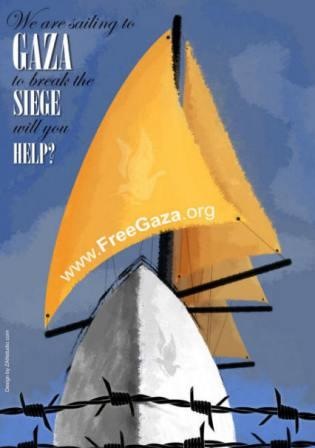
Next week I am going to be traveling between Istanbul, Athens and Nicosia. I will be giving concerts and talks in support of the coming Free Gaza flotilla. In the last few days, I gave many interviews to Greek papers. Here is one. I guess that it sums up many of my thoughts about Israel, Zionism, Jewish identity, Palestine, Gaza and the Free Gaza mission.
Q. Where were you born and where did you spend your early years?
GA: I was born in Israel in 1963. It took me many years before I realized that the place I was born in was in fact occupied Palestine.
Q. Musician, author, activist, philosopher – which of these identities suits you most?
GA: I am a Jazz musician. In ideal terms I would love to see myself as a person who reinvents himself on a daily basis. This is obviously a wet fantasy, a task almost impossible to achieve. But it is something to aspire to. I am academically trained as a philosopher and believe that German philosophy sets the right framework for an articulate, ideological, ethical and universal thinking. I am also an author yet I do not regard myself as an activist. I have never understood what activism stands for. I may as well mention that I am not interested in politics but rather in meaning and implications of political activity and political thinking.
Q: Why do you oppose your Jewish and Israeli identity?
GA: I do not oppose Jewish or Israeli identity. I oppose any possible form of Jewish politics and indeed any identity politics. The reason is simple. Since Jewish identity is racially orientated, every permutation of Jewish politics is racist to the bone and I am obviously against racism. In fact, Israel and Zionism was originally an attempt to rescue the Jew from racist politics and racial political orientation. Zionism invented the Jewish nation. (or: Jews as a nation). Early Zionists attempted to present the Jews as a people amongst other people instead of a distinct race. This idea looked fine on paper, yet, the reality of the Jewish state proves that Israel is the most radical form of Jewish chauvinism. The Israeli legal system is totally discriminatory toward non Jews. Israeli policies are no different form Nazi racial laws.
Q: What was it that hurt you so much as to state publicly that you fight the Israeli in you? Don’t you feel that this is a harsh statement to make? A statement that shows anger?
GA: Yes I am indeed angry. Watching 1.5 million Palestinians being starved in Gaza makes me angry. Watching the IDF throw bombs and white phosphorous on elders, women and children who seek shelter in an UNRA compound makes me angry. Watching the Israeli air force flatten Lebanon in 2006 made me angry. Watching the holy land get sliced by a gigantic separation wall makes me angry. Transforming Palestine into a Jewish bunker makes me angry. Meeting dispossessed Palestinian refugees who cannot even visit their land makes me very angry. Realising that 1.5 million Iraqis lost their life because of a Zionist global war designed by Ziocon Wolfowitz makes me furious. Zionists advocating the Killing of Muslims in the name of moral interventionism freaks me out. Watching AIPAC promote more wars and violence makes my blood boil.
Q: Don’t Israelis or Jews have the right for a national homeland, a safe homeland that is?
GA: Strictly speaking the answer is NO. If the Jews ever had a right for a national home, they lost this right a long time ago. As we know Zionism celebrated the Jewish national revival at the expense of the Palestinian people.
Would you allow a bunch of Italian lunatics to invade your home in Athens just because they are convinced that your dwelling was once part of the Roman Empire? They could claim that your home was a property of their Roman forefathers. Clearly, Italians wouldn’t get away with it, but Zionists did, at least for a while.
There is no right for a racist state that celebrates its tribal symptoms at the expense of others. There is no room for Israel amongst the nations.
Q: What concessions have to be made for Palestinians to live free and prosper?
GA: Pretty simple. Israel must become a state of its citizens. At the moment a Jew in Brooklyn enjoys more rights in Palestine than a Palestinian who was born on the land.
Q: Why should Israelis cut down on armaments? Is it not the case that the increase in military equipment is due to their sentiment of insecurity, as they are surrounded by Arabs?
GA: It doesn’t matter anymore whether Israel cuts down on armaments. Israel’s defeat is inevitable. In 2006 the entire Israeli military was humiliated by a small paramilitary organization namely the Hezbollah. In 2009 Israel didn’t achieve any of its military objectives in spite of the massive deployment of IDF units and the collective punishment of civilians by using extreme military measures against civilians including WMDs. The Israelis employ more and more force, they entangle themselves in more and more colossal war crimes, the legitimacy of the Jewish State is a matter for historians. The doomed fate of Israel is written on the wall.
Q: Do you believe that Jewish people still feel unwanted, even though so many decades have passed since the Holocaust?
GA: It is hard for me to talk about Jewish people, for I do not know all Jews. However, Jewish politicians always emphasize the fear of anti Semitism. All forms of Jewish politics present different methods of raising barriers between Jews and others, Zionism is there to separate the Jew from the Goy, the Bund (Jewish socialists) is also there to separate the Jew from the working class, the Jewish left is there to set a tribe of chosen people amongst peace lovers.
Q: Could Israelis and Palestinians live in peace?
GA: Not in a million years. The notion of peace and reconciliation are foreign to the Israeli ideology, politics and Identity. When an Israeli says Shalom, they do not mean peace, they actually mean ‘security for the Jews’. This self-centric mode was identified by Christ 2000 years ago. Love your neighbour and turn the other cheek was Jesus’ lesson. Israel on the other hand seeks collective gratification through revenge. According to the Jerusalem post 94% of Israeli Jews supported the 2009 IDF air raids against Palestinian civilians. There is no way to describe the fact above other than as an extreme form of lethal tribal barbarism.
For Israelis to live in peace, a metamorphic shift of consciousness is needed instead of a political shift.
Q: In what way can the “Ship to Gaza” help resolve the Israeli–Palestinian conflict?
GA: It is not there to resolve the conflict. It is there to first of all: Bring necessary aid to the people of Gaza. Secondly: It is there to raise media and public awareness of the ongoing colossal Israeli war crimes against humanity.
I would add that since the Palestinians are at the forefront of the war against modern evil. The Free Gaza is not just a humanitarian effort, it is actually a call from humanity, it is there to remind us all what humanism stands for.
Q: You are the founder of the “Orient House Ensemble”. What is it mainly about?
GA: Initially I wanted to Palestinise some Jewish tunes. I naively believed that if we play Israeli and Jewish tunes about homecoming implementing Arabic scales, Jews and Israelis may open their heart to the Palestinian cause. In fact some Jews and Israelis have followed our line of thinking. However, many people in the UK and around the world realized what we tried to achieve. Our message wasn’t a break through in Israel but we found many attentive ears around the world. We are playing together for almost 10 years. We do not have any plans to stop.
Q: How can the Greek people stand up against the imminent new reality?
GA: I travel all over the world and I can reassure you that the Greeks are at the very forefront of supporting Palestine. To oppose Israel is an ethical priority. All we have to do is to say what we believe and not to shy away from saying it loudly and proudly.
Here are just a few lines from Nahida's deconstruction of 'Anti Semitism':
.........This occupying entity called “Israel” (a word that I myself detest to even pronounce and generally avoid to use) is not a theoretical being, nor does it operate in a vacuum; it’s neither an abstract concept nor a conjectural void
It’s an entity run by PEOPLE
PEOPLE who make decisions,
PEOPLE who elect politicians
PEOPLE who ALL serve in a barbarian army
PEOPLE who foster racist beliefs, attitudes and actions
PEOPLE who invaded others’ land, dispossessed them, and forcibly occupied it
PEOPLE who imprison children and shoot babies hearts
PEOPLE who destroy world heritage
PEOPLE who steal water, land, sea and sky
PEOPLE who kill hope, life, beauty and smiles
PEOPLE who build their colonies on the blood and ruins of another people
It is an entity of PEOPLE, 94% of whom voted for the attack on Gaza
It is an entity of PEOPLE, 71% of whom want U.S. to strike Iran
It is an entity of PEOPLE who violated and assaulted ALL neighbouring countries
It is an entity of PEOPLE who live on a STOLEN land for over six decades, with no signs of shame, remorse, awakening of conscience, or willingness to neither admit nor right the wrongs they’ve committed
To read it all
http://uprootedpalestinians.blogspot.com/2010/05/about-anti-semitism.html
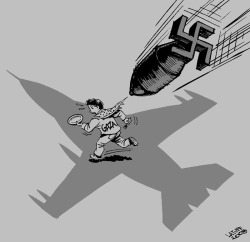
Cartoon by Latuff
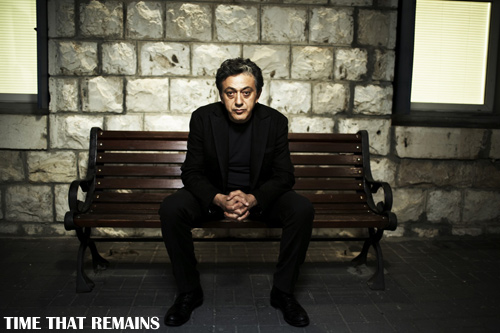
The London Palestinian Film Festival opened this year with Elia Suleiman’s latest feature “The Time that Remains” (105min), a monumental reflective and poetic take on Palestine since 1948.
To a certain extent Suleiman’s latest film reminded me of Ramzy Baroud’s book My Father Was a Freedom Fighter. Both works chart a personal and devastating expedition into hopelessness. Both accounts are saturated with repeated failures and betrayals, both Baroud and Suleiman are courageous enough to criticise their collective narrative and yet, both pepper their story with some staggering wit, hope and humour. They make you smile just when you are about to sob.
To watch trailer:
http://www.youtube.com/watch?v=ZmUPHXAC3Lk
Available on YouTube (with age restriction):
http://www.youtube.com/watch?v=Fw8a3W-Ir4E
Posted by Mo

Scottish hero comedian Frankie Boyle has accused the BBC Trust of cowardly behaviour.
Boyle published an open letter describing the situation in Palestine as "in essence, apartheid" and lamenting the fact that the BBC was "now cravenly afraid of giving offence and vulnerable to any kind of well-drilled lobbying".
Back in 2008 Boyle made an astute joke on BBC’s Radio 4 programme Political Animal. "I've been studying Israeli army martial arts. I now know 16 ways to kick a Palestinian woman in the back. People think that the Middle East is very complex but I have an analogy that sums it up quite well. If you imagine that Palestine is a big cake, well … that cake is being punched to pieces by a very angry Jew."
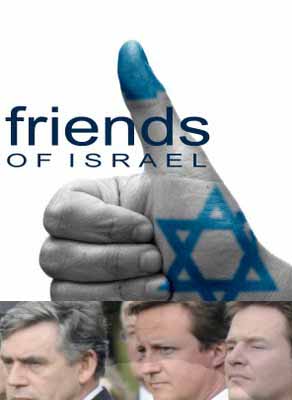
With Britain’s three-way race for prime minister entering the final lap, many Brits are still wondering who to vote for. As if it makes any difference. However, if you are interested in my take on the subject, I would suggest you opt for Nick Clegg and the Liberal Democrats. If you want to know why, it is pretty simple - just because the Jews don’t like Clegg at all. This is at least the impression I gathered after reading the Jewish Telegraphic Agency (JTA).A Channel 4 "Dispatches" Documentary aired March 15 2010 - Posted by Mo
Which Hand Do You Write With?
Schools in our refugee camp were closed for extended periods, as were schools throughout the Gaza Strip. On one such typical school-free morning, my brothers and I were sleeping late. My mother was ready to watch an early morning re-run of “MacGyver”, an American TV show that was aired on Jordanian television. Sometimes she asked me to read the subtitles, but on that morning, she was content to watch MacGyver without my commentary, as he turned negligible everyday items into impressive devises that bewildered his adversaries. My father was locating the channel as my mother went to prepare the morning tea.
Unexpectedly, I was awakened by a large boot pressing against my face. My older brothers were particularly bothersome, but stepping on my face while sleeping was even too cruel for them. I woke up to find a swarm of soldiers inside the house and standing over me. They pushed the main door open, walked in quietly, and found their way into the main bedroom where my brothers and I were sleeping. Anwar was a heavy sleeper, and only woke up after two soldiers began violently kicking him and his mattress.
My mother came running from the kitchen, thinking the chaos was the result of a morning scuffle between her five sons, only to find an Israeli army unit handcuffing her children and dragging them out into the street. The event was customary. Soldiers often stormed into people’s homes and broke the arms and legs of men and boys so as to send a stern message to the rest of the neighborhood that they would receive the same fate if they continued with their Intifada.
My father spoke good Hebrew, which he learned during his years of business dealings in Israel. My mother spoke none, but even if she did, she would not have been able to articulate one legible sentence. After a brief pause, she let out a howl, and cried out to one of them, “I beg you soldier. My sons were sleeping. They have done nothing wrong. I kiss your hand, don’t break their arms. I beg you, may Allah return you safe and sound to your family. How would your mother feel if someone came to break her children’s arms? Oh Allah, come to my rescue. My children are the only thing I have in this life. Oh Allah I was raised poor and orphaned, and I don’t deserve this.”
At first, the soldiers paid no heed to my mothers’ pleas, and merely responded with “shut up and go inside”, but her crying alerted the women in the neighborhood, who served as a first line of defense under such circumstances. Neighborhood women gathered outside their homes, screaming and shouting, as soldiers lined us against the wall and brought in their club. The custom was for the soldier to ask a person singled out for a beating, “Which hand do you write with?” before the club would break it, followed by the other arm, and then the legs.
When the soldier asked one of my brothers the same ominous question, my mother’s pleas turned into unintelligible cries as she dropped to the floor and held onto one of the soldier’s legs with a death grip. The soldier tried to free himself, as two others came to his rescue, pounding the frail woman over and over again in the chest with the butts of their machine guns, and as my father forced his body between the angry solider and the desperate mother.
Made more courageous by the violent scene, especially as my mother seemed to be drowning in the gush of blood flowing from her mouth, neighborhood women drew closer, throwing rocks and sand at the soldiers. What was meant as an orderly beating of several boys, turned into a chaotic scene where women braved guns and tear gas and verbal abuse by Israeli soldiers, who eventually retreated into their military vehicles and out of the area.
Thanks to my mother, our bones were left intact that day, but at a price. She was left bruised and bleeding. Her chest was battered and several ribs were broken. She was rushed to a local hospital and was incapacitated for days. Her health deteriorated to the bewilderment of Ahli hospital doctors who hoped for an eventual recovery. Days later, doctors discovered that my mother had multiple myeloma. Apparently she had been sick for some time, but her illness was exacerbated by the violent encounter, which made her prognosis bleak.
With this, she announced to the family that she wished to die at home, for there was nothing that under-equipped local hospitals could do to help. My father would not even entertain such a notion. But how do you treat a cancer patient, with broken ribs, without health insurance, with little money and in an area that is paralyzed by strikes, curfews and daily violence?
Odyssey
My father used what remained of the family savings to treat my mother’s aggressive illness. He hired a taxi that accompanied them to clinics, hospitals and pharmacies. On days when general strikes were announced, they had to walk, at times for hours. They were frequently absent, and when they returned, they were exhausted. My mother would throw herself on her bed, and my father would sit for prolonged periods dividing his time between coughing and crying.
But my mother got even weaker, and as time passed she was unable to move without suffering severe pain. My parents resolved that they could no longer leave us alone in our neighborhood, which had become a very dangerous area, thus we were dispatched to ‘safer’ places; the home of relatives, friends and, at one point, a little shack in the middle of an orchard, with no running water, no electricity and the constant fear of being discovered and maybe killed by Israeli soldiers.
My two older brothers were sent to stay at a friend’s house, near Gaza City, while I and my two younger brothers were left in the hut in the Gaza orchard. My mother was hospitalized in Gaza City, and my father divided his time between us and her. Whenever he arrived, carrying bags of bread, apples, bananas and water, we ran to greet him. His news was increasingly grim. “Your mother’s fate is in God’s hands,” was his oft-repeated medical assessment. Finally, he decided to take her to Egypt to be treated at the Palestine Hospital in Cairo. Zarefah resisted. She told him that she would rather die in her house in the refugee camp, but he maintained that there was still hope and that he would not give up until his last breath. They went to Egypt, along with my younger brothers. My older brothers and I were relocated to a small room atop the roof of a building in Deir al-Balah. We had no telephone, and soon ran out of money. Two months later, my parents returned.
The Car Downstairs
I was awakened by a friend who told me in a somber voice that my parents were home. He wanted to elaborate, but I gave him no chance, throwing the cover to the side and running to wave to them from the roof. My father was being embraced by neighbors, as he stood by a truck with an open flat-bed. Inside the truck was a coffin draped with a Palestinian flag. It was my mother. My father soon came upstairs. He hugged us and we all cried. He gave be a small plastic bag, filled with knickknacks that my mother had bought me in Egypt. “She sent you her love and many kisses,” my father said. I hid her gifts under my mattress, and joined the rest to the refugee camp to bury her.
Nuseirat was under a curfew, and the Israeli army agreed to allow her burial on the condition that only the immediate family was to be present under the monitoring of Israeli soldiers. We arrived at the graveyard, carrying the coffin and were soon joined by Mariam, Zarefah’s mother, who came running into the graveyard calling out her daughter’s name. We began digging, but neighbors peeking through their windows quickly concluded that Zarefah has died and was being buried. My mother was a beloved neighbor. She was particularly adored among the older women of the camp, whom Zarefah treated with untold kindness. “Allahu Akbar,” resonated a voice, coming from one of the refugee homes. “Um Anwar has died” cried another. Within minutes, shouts of “God is Great” echoed throughout the camp. People appeared from everywhere, carrying Palestinian flags; women, children, old men and women, and youth, all descending onto the graveyard. Refugees were outraged that the poor woman was to be buried based on military instruction, and was followed, even to her grave, under the watchful eyes of the occupiers, their guns, tanks and a hovering army helicopter. Youth began throwing stones, and soldiers responded with bullets and teargas. But the people were not to disperse easily this time. Thousands of them ensured that Zarefah would depart the earth and enter Paradise in the company of friends, treated as a martyr should be treated. As an ambulance hauled some of the wounded to the local clinic, Zarefah was lowered in the ground amidst chants and Quranic verses, recited en mass. Shouts of “Allahu Akbar” were intermingled with the whimpers and prayers of the crowd, the sound bombs, the teargas, and the hovering helicopter. My mother was 42-years-old when she died.
English: http://www.tlaxcala.es/pp.asp?reference=10396&lg=en
French: http://www.tlaxcala.es/pp.asp?reference=10398&lg=fr
Swedish: http://www.tlaxcala.es/pp.asp?reference=10397&lg=sv
Last weekend the American National Security Adviser, General James Jones, spoke at the 25-year anniversary gala of the Washington Institute for Near East Policy*. Mindful that the crowd consisted of many Jews, General Jones believed would be an appropriate, friendly gesture to launch his speech with a Jewish Joke. He was obviously wrong.