David Mamet Vs. Gilad Atzmon

David Mamet, Gilad Atzmon and identity politics

There are unexpected similarities between two writers usually thought of as polar opposites. The author ends up wishing that each of them would write their version of an imagined encounter with the other.

Reading Gilad Atzmon's The Wandering Who? [5] immediately after David Mamet's The Secret Knowledge [6], I was surprised to find the two books, written from vehemently opposed political viewpoints, nonetheless reminded me of each other. Does Mamet's need to see the Israelis only as scapegoats grow from the same root as Atzmon's need to see them only as perpetrators? An underlying emotional argument of Mamet's The Secret Knowledge [6] could be glossed as “I used to be a poster child for liberalism, so all the more reason to believe me now I reject everything about liberalism.” For an underlying emotional argument of Atzmon's The Wandering Who? [5] substitute “Zionism” for “liberalism.” But even if this were a compelling line of argument, each book contains plenty of evidence Mamet and Atzmon were never exactly poster children.

Mamet's plays and other writings celebrate individual courage, discipline, and commitment. While he has only recently started identifying as a conservative, his long-term distrust of academia and high estimation of street smarts, his generally low opinion of human nature and belief that playing the victim card is a more contemptible route to power than is straightforward self-interested chicanery – while arguably bipartisan attitudes -- in the contemporary U.S. tend to be more associated with the right. It's not surprising if a man whose plays observe the Aristotelian unities of Time, Place and Action leans conservative, while when it comes to Israel – more likely the driving factor behind Mamet's political conversion – he has for some time been on the right of Israel's foreign policy spectrum. According to The Secret Knowledge [6], he now desires a Republican victory in the U.S. in 2012 and the repeal of health care reform, Israel's infallibility apparently not extending to its system of socialized medicine. Mamet loves America and Israel for their entrepreneurialism, and tends toward the neocon line that Israel is the front line in the “War Against Terrorism,” and that anyone criticizing the Israeli government's treatment of the Palestinians must be an anti-Semite. Mamet reports he is now ashamed not to have fought in Vietnam, a lack for which his more recent hawkishness could be seen as a bid to compensate.

Read More

Deconstructing Avraham Burg

By Gilad Atzmon

I respect former Knesset speaker Avraham Burg. Over the years, Burg has managed to extend the scope of the Zionist self-criticism; he has challenged the Zionist discourse, Israeli society and even Jewish identity politics. A few days ago, in a New York Times opinion piece, he attempted to explore the reasons behind the collapse of Israeli democracy.

Burg seemed alarmed by the way in which the relationship between Israel and America has evolved. “When an American presidential candidate visits Israel and his key message is to encourage us to pursue a misguided war with Iran… we know that something profound and basic has changed in the relationship between Israel and the United States.”

Burg was obviously referring to Mitt Romeny’s grave comment in Jerusalem last week. But, in his analysis of the relationship between the two warmongering states, Burg may have failed because, in reality, nothing much has changed in recent years. On the contrary, the true nature and deep cultural, ideological and spiritual bond between America and Israel is now clear for all to see.

Read More

Dismembering the Arab World

by Makram Khoury-Machool

Dr Makram Khoury-Machool is a Palestinian scholar, based in Cambridge, UK

http://www.deliberation.info/dismembering-the-arab-world/

 The behaviour of the NATO-aligned, anti-Syrian bloc is now blatant enough for us to better understand what is happening in Syria. On the one hand, we find political operators such the ad-hoc group ‘Friends of Syria’, and on the other, two Arab personalities, both ministers of two Gulf sheikhdoms.

The first group includes NATO-led heads of states, with a barely disguised Israeli master-plan conceived by the likes of Bernard-Henri Lévy. Rather than being the friends of Syria, these personalities are arguably working to secure their own financial interests in, around, and via Syria. The two Arab politicians are the two foreign ministers ofSaudi ArabiaandQatar. They have declared that those forces acting violently against the Syrian state should be armed and financially supported. In short, these conventions of the so-called ‘Friends of Syria’ are probably no more than a ‘modern’ version of those meetings conducted by Viceroy Lord Curzon, who, in 1903, addressed the ‘Chiefs of the Arab Coast’ on HMS Argonaut in Sharjah (UAE).

The Qataris and Saudis give financial support to the ‘rebels’ for weapons, payments to fighters and mercenaries, and logistical oversight of attacks on Syria. All of this is in addition to their support with telecommunication services, combat tactics, and strategic military advice. Unsurprisingly, the Western military advisors, who operate for the armed groups behind the scenes, do not feature in any media outlets. Neighbouring states also provide geographical assistance to the armed groups, with Jordan providing a passage for mercenaries from Libya, and Turkey acting as the northern military base for operations.

Turkey is involved because of its wish to align itself with the Saudi-Sunni, NATO-backed line and also its fear that a dismembered Syria would lead to the promotion of Kurdish autonomy. In their eyes, this could bring about the eventual union of the Kurds with Iraqi and Syrian Kurds and then lead to civil war with Turkey and the eventual separation of Kurdistan from Turkey and the creation of a Kurdish state.

For its part, Israel has for decades planned, as part of its strategy to dominate the Middle East and the Mediterranean, to weaken Syria in order to continue its occupation of the Syrian Golan Heights and to dominate water sources. Essentially, Israel wants to be the main economic and military power in the region and indeed, Israel may well emerge from the weakening ofSyria as the main winner, if only in the short-term.

Through its orchestrated media campaigns transmitted over the decades to its  own public,Israel has constructed a concept of Syria as the major threat to its existence in the Arab world. Arguably, the governmental vacuum that might be created in Syria could be filled by al-Qaeda-like groups giving sufficient justification for Israel’s actions (against Syria and/or Iran) and would also promote the idea of a conflict between ‘civilized-democratic’ Israel and ‘savage’ Islamists.

Despite huge differences between Syria and Libya, Syria’s fate could be similar to that of Libya in terms of direct foreign intervention, were not Russia and China firmly opposed such actions at the UN, where there has been consistent cooperation between the two. Although the origins of Sino-Soviet relations go back to the early days of the 1917 Communist Revolution, it seems that, even two decades after the dismantlement of the Eastern Bloc, the Russian Federation and the Republic of China are, more than ever, following what Mao Tse-tung advised in his ‘Be a True Revolutionary’ address on 23 June 1950. Here, Tse-tung said that ‘in the international sphere we must firmly unite with the Soviet Union’ (see Selected Works of Mao Tsetung, vol. V. p. 39). Shared ideology, world vision, economic interests, and objectives in the field of energy have brought Russia and China ever closer together over the Syrian conflict.

Read More

Mezvinsky & Atzmon on Heidegger's Podium

Dear friends

I am away (with no internet or wifi connection)  for 3 weeks finishing a new  book and teaching Jazz.

However, I just learned that my talk for Cafe Palestine @ Freiburg University is now available on youtube.

Last month I toured Germany, Austria and Switzerland  together with Frank Harrison and Dr Gabi Weber     for 3 weeks. I gave talks about music and Jewish identity ahead of the publication of the German edition of The Wandering Who (October 2012). The legendary American historian Prof. Norton Mezvinsky Joined us for three days.

The following is our joint talk in Freiburg University on 03.07.2012 (German translation by Dr. Gabi Weber)


Gilad Atzmon on The Wandering Who

http://youtu.be/Ka6HGnXfWdE


Prof. Norton Mezvinsky on Jewish Histroy, Zionism and Israel

http://youtu.be/loB3mTXKQw4


'Obama is not good for the Jews' says Michael...

The first in a series of ads by the Republican Jewish Coalition, highlighting the real stories of real Jewish people who give voice to the nagging Jewish doubts that many in the Jewish community feel about President Obama.


The Wandering Who? A Study Of Jewish Identity Politics, Jewish political interest, Jewish Lobby and beyond..

The book can be  ordered  on Amazon.com  or Amazon.co.uk

Bigot Vs. Bigot

Bigot Vs. BigotThis is a rare and important debate between infamous ultra-nationalist Rabbi Meir Kahane and the caricature Harvard Prof’ Alan Dershowitz.
In the debate, that took place in 1985, Rabbi Kahane explores a thoroughly coherent and consistent notion of Jewishness derived from self love, Jewish orthodoxy and the Torah. He grasps the true (and rather obvious) supremacist meaning of the Jewish state having to be primarily Jewish. Kahane’s views were not popular in Israel at the time, (he insisted that Arabs and Palestinians had no future in Israel so, he wanted them gone) but today, Kahane’s views are widely accepted in Israel and not at all different from Israeli Foreign Minister Avigdor Liebermann’s political agenda.

But what is really interesting is to watch the role of Alan Dershowitz. Even in 1985, our infamous spin-master could not produce one genuine or truthful statement

Read More

DONOR OPIUM, the impact of international aid to Palestine (MUST WATCH)

For twenty years now the international donor community has financially supported Palestinian institution-building, infrastructure development, the economy, public employees' salaries, health and education, social welfare, the police, electricity production, private credit guarantees, and the bigger part of the civil society organizations with regards to democracy promotion, human rights, tolerance, women rights etc.

Peace and the establishment of a Palestinian state have been the declared goals of all the support. But actual results are the fragmentation and pacification of the Palestinian people.

This documentary film, directed by Mariam Shahin and George Azar, and funded by the Rosa Luxemburg Foundation, features Palestinian criticism of this externally funded "development".

Dr Anthony Löwstedt on The Wandering Who


In this book Atzmon moves effortlessly between disciplines and perspectives. It is an exhilarating read, from the atemporality of immoral action to the temporality of morals, from Jewish suffering to supremacy and expansionism to the categorical imperative, and from guilt feelings to responsibility. It is most interesting to follow Atzmon's diagnosis of the Israeli-Jewish mental state. He looks for signs of schizophrenia and neurosis and finds them abundantly, as well as a new mental disorder, a form of psychosis, which he names 'pre-traumatic stress syndrome', a consequence of intense elite politics of fear. He also finds it among Zionist and crypto-Zionist Jews in the Diaspora. Atzmon is keenly aware that not only Jews but many other groups of people have developed similar symptoms, e.g. white South Africans and Americans at home, or Americans in Iraq and Afghanistan, or Blair and Bush, or the National Socialists in Germany and elsewhere. They are not essentially unique to Jews, but perhaps to conquerors, people who have conquered other people militarily, and whose mental states are disturbed by their relationship with those people, a relationship of violence, dominance, control, expropriation, exploitation, hatred, and disgust, and, naturally, of indigenous resistance to all of that. Sometimes provocative and emotional, often brash, but funny and always entertaining, Atzmon has a simple, humanistic, and very hopeful message: If you want to feel better, then make peace with justice with those people, with the Palestinians. This whole thing can be started, and perhaps as much as half of it finished, in the course of a single afternoon. 

The Wandering Who? A Study Of Jewish Identity Politics

The book can be  ordered  on Amazon.com  or Amazon.co.uk


Farewell, Alex, My Friend by JEFFREY ST. CLAIR

Introduction by Gilad Atzmon: I have learned today that the widely admired Alexander Cockburn, co-editor of the invaluable Counterpunch Magazine, passed away last week. Alex was, no doubt, amongst the leading voices of dissent and Counterpunch, which he founded with Jeffrey St. Clair, has been the prominent English alternative media outlet for more than a decade.

Alex was a great supporter of Palestine, justice and free speech. He was quick to offer support to younger writers, myself included. Alex will missed!

I will use this opportunity to express my deepest condolences to Alex’s family and Counterpunch.

Farewell, Alex, My Friend

by JEFFREY ST. CLAIR
Alexander Cockburn, 1941-2012

Our friend and comrade Alexander Cockburn died last night in Germany, after a fierce two-year long battle against cancer. His daughter Daisy was at his bedside.

Alex kept his illness a tightly guarded secret. Only a handful of us knew how terribly sick he truly was. He didn’t want the disease to define him. He didn’t want his friends and readers to shower him with sympathy. He didn’t want to blog his own death as Christopher Hitchens had done. Alex wanted to keep living his life right to the end. He wanted to live on his terms. And he wanted to continue writing through it all, just as his brilliant father, the novelist and journalist Claud Cockburn had done. And so he did. His body was deteriorating, but his prose remained as sharp, lucid and deadly as ever.

In one of Alex’s last emails to me, he patted himself on the back (and deservedly so) for having only missed one column through his incredibly debilitating and painful last few months. Amid the chemo and blood transfusions and painkillers, Alex turned out not only columns for CounterPunch and The Nation and First Post, but he also wrote a small book called Guillotine and finished his memoirs, A Colossal Wreck, both of which CounterPunch plans to publish over the course of the next year.

Alex lived a huge life and he lived it his way. He hated compromise in politics and he didn’t tolerate it in his own life. Alex was my pal, my mentor, my comrade. We joked, gossiped, argued and worked together nearly every day for the last twenty years. He leaves a huge void in our lives. But he taught at least two generations how to think, how to look at the world, how to live a life of joyful and creative resistance. So, the struggle continues and we’re going to remain engaged. He wouldn’t have it any other way.

In the coming days and weeks, CounterPunch will publish many tributes to Alex from his friends and colleagues. But for this day, let us remember him through a few images taken by our friend Tao Ruspoli.

Alex and Jasper. Photo: Tao Ruspoli

Read More

A War Israel is Just Begging for an Excuse to Start

By Gilad Atzmon

Just hours after the attack on Israeli tourists in Bulgaria, Israeli PM Benjamin Netanyahu and his Defence Minister Ehud Barak were quick to announce that Iran and the Hezbollah were behind the attack. In fact, it didn’t take the Israeli PM more than two hours to blame another country for committing an act of war on Israeli citizens in a third country’s territory. Of course, Netanyahu didn’t provide any evidence to support his thesis. In fact, even today, three days after the attack, no clear leads suggesting any Iranian or Hezbollah's connection are available.

What was it then that made Netanyahu so determined? Is it because he himself was privy to the knowledge that Israeli agents have been murdering Iranian scientists for years? Did Netanyahu react the way he did because he thought to himself that considering Mossad’s assassinations in Tehran, Israel may well have brought on itself an Iranian retaliation? Was Bibi projecting?

I obviously do not have access to Netanyahu or Barak’s minds, but Israel has certainly by now made it clear that its desperation to attack Iran's nuclear facilities, even if such an attack would escalate into a global nuclear conflict. In order to grasp such morbidity we have to bear in mind that collective self-annihilation is inherent to Israeli culture. As it happens, the story of Masada and Samson, both heroic suicidal narratives, are cherished in Israel. Yet, as much as Netanyahu and Barak are keen to launch a world war, it is far from being clear whether the Israeli masses are quite as keen to sacrifice themselves on the Jewish national altar.

I guess that both Barak and Netanyahu’s rush to blame Iran must be seen as an indication of their clear eagerness to attack the country. By now, the two Israeli leaders have managed to rid themselves of any significant voices against such an attack. The former head of Mossad Meir Dagan and IDF Chief of Staff Gabi Askenazi, both of whom opposed military action against Iran, are now excluded from any decision-making process. Veteran Major-General Shaul Mofaz, the leader of the Kadima party, who also opposed an attack on Iran, left Netanyahu’s coalition last week. It seems as if no one within the Israeli cabinet is there to stop Barak and Netanyahu’s genocidal enthusiasms.

Read More

Gilad and All That Jazz - Great Film Review by Selwyn Harris/Jazzwise

http://www.jazzwisemagazine.com/

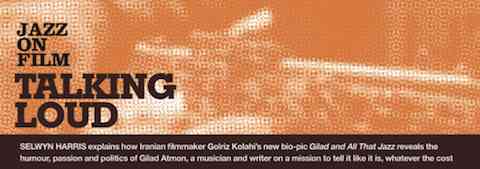
SELWYN HARRIS explains how Iranian filmmaker Golriz Kolahi’s new bio-pic Gilad and All That Jazz reveals the humour, passion and politics of Gilad Atmon, a musician and writer on a mission to tell it like it is, whatever the cost

Gilad and All That Jazz Trailer from David Alamouti on Vimeo.


There is a good deal of live music footage throughout revealing the different sides to Atzmon’s music: appearing with the Blockhead Ian Dury on Jools Holland’s Later, with Robbie Williams at a later tribute to Dury right through to his own projects: The Orient House Ensemble with Nigel Kennedy at Chelsea’s 606 club, and on a concert stage with his fairly recent Parker and

Larger than life characters are the lifeblood of the jazz documentary. One such release that was featured here just recently Sounds and Silence sheds some light on the intensely private, arcane world of the German ECM label head Manfred Eicher. Mystery though isn’t a word you’d associate with Gilad Atzmon, the subject of a new documentary by the Iranian filmmaker Golriz Kolahi. The expat London-based Israeli reedsman is a working jazz musician with a story to tell. Selected for screening at this year’s London International Documentary Festival, Gilad and All That Jazz emerged from an idea Kolahi had for a series of documentaries about artists who use their art as a political platform. Atzmon is one of a kind. In jazz terms, his allegiances spread across the mainstream of bop, R&B and Coltrane spiritualism. But they are often given a subversive, sometimes humorous cabaret-ish twist when infused primarily with the roots music of the Middle East, but also north Africa, eastern Europe and the Jewish diaspora. In his own words he “likes to take Jewish music and Palestinian-ise it.” Atzmon’s political activity isn’t just connected to his music making. He’s also proved an increasingly outspoken and controversial essayist, blogger and author, but humour is never far away.

Read More

How leftist "anti-zionists" are allied with Israel against Syria


By Mimi Al Laham (aka "Syrian Girl") and Lizzie Phelan


The Myth
There has been a ridiculous notion amongst numerous left groups and those opposed to the Syrian government, that the Israeli regime does not want to see Assad fall. As self-professed “anti-zionists”, many in these groups are content to delude themselves into believing that both their enemies are on the same side. In the case of several socialist groups, they believe that this forcing of the Syrian crisis into their blanket “anti-authoritarian” narrative (regardless of the state in which they are applying that narrative to) enables them to maintain a façade of anti-imperialism. 


London based socialist newspaper The Socialist Review writes: “Israel, although hostile to Syria, could depend on the Baathist regime to keep the frontier quiet. Thus criticism of Bashar is more muted in Tel Aviv.”

And Simon Assaf of the SocialistWorker writes: 
The notion that ordinary Syrians struggling to change their country are the pawns of a ‘Western plot’ is absurd…In fact the Arab League is attempting to throw the regime a lifeline.  

This view is also pervasive amongst the Islamic opposition to the Syrian government. Rafiq A. Tschannen of the The Muslims Times writes:

Read More

Burner against Burner


By Gilad Atzmon

http://www.deliberation.info

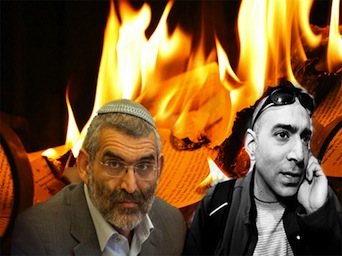
Earlier this week we learned that Israeli Knesset Member Michael Ben-Ari (National Union) tore the New Testament to pieces and then threw it in the trash.

MK Ben –Ari was quoted as saying  “This abhorrent book (The New Testament) promoted the murders of millions of Jews during the Inquisition and the autos da fé… this is an ugly missionary provocation by the Church, there’s no doubt that the book and its senders belong in the trash of history.”

Unfortunately, such a disgraceful attitude towards a text is no more or less than  one would expect from a Zionist Jew, after all, herem, excommunication, boycott and book burning are all firmly embedded in both Jewish culture and Jewish politics.  Still, I was a little surprised to read Ali Abunimah’s critical report on the event, because, only three months ago Abunmiah himself joined forces with Abe Foxman, Alan Dershowitz  and the entire AZZ community in a desperate book burning campaign. That time it was my book The Wandering Who? that was the ‘abhorrent book’ desperately in need of binning.

idiots

United in their loathing of One man and his Book

Read More

Russian Spring Cancelled – Nyet to NGOs

introduction  by Gilad Atzmon:  Time is ripe to look into NGOs (non-governmental organizations), what they are and who stand behind them. In the following Deliberation piece, Jonathon Blackeley explores recent shift in Russian attitude towards NGOs. I may as well confess that in the last few weeks I have been looking into Palestinian NGOs and their funders. My findings are pretty concerning...

Russian Spring Cancelled – Nyet to NGOs

http://www.deliberation.info/russian-spring-cancelled-nyet-to-ngos/

by Jonathon Blakeley

In a wonderfully chess-like move, the Russian Parliament skillfully moved to block attempts to de-stablize Russia by using NGOs to encourage dissent.  AlJaZeera reported today that a new law had been passed with only one vote against and one abstention. The law would limit the operation of NGOs in Russia. Specifically foreign-funded NGOs would have to declare that they are foreign agents on all their publicity materials.

But what are NGOs exactly?

No one describes the NGOs better than Phyllis Schlafly who has watched them for decades: “The NGOs are energetic lobbyists for dramatic changes in the mission and structure of the UN to achieve global governance.  Most NGOs are also members of the International Union for the Conservation of Nature (IUCN), which originated many of the global environmental polices set forth in the Convention on Biological Diversity, the Convention on Climate Change, and Agenda 21.  The most prominent NGOs are the radical environmental groups such as the Sierra Club and the feminist and population-control groups such as Planned Parenthood.”

This Russian ruling against NGOs also links in a rather oblique way to another recent Court ruling in Russia which controversially banned Gay (LGBT) Parades for  the next 100 years. The two events are linked because it is through this kind of cultural marxism of the NGOs that countries are being taken over all around the world. It is plain to see and the Russians are no fools. The World Order has been using a variety of techniques to subvert and take over countries round the globe, economic hit-men, Cyberwar  & fake-liberation is very popular these days. But it turns out that Russian law change was only following in the foot-steps of those other great revolutionaries… The Iranians.

Read More